
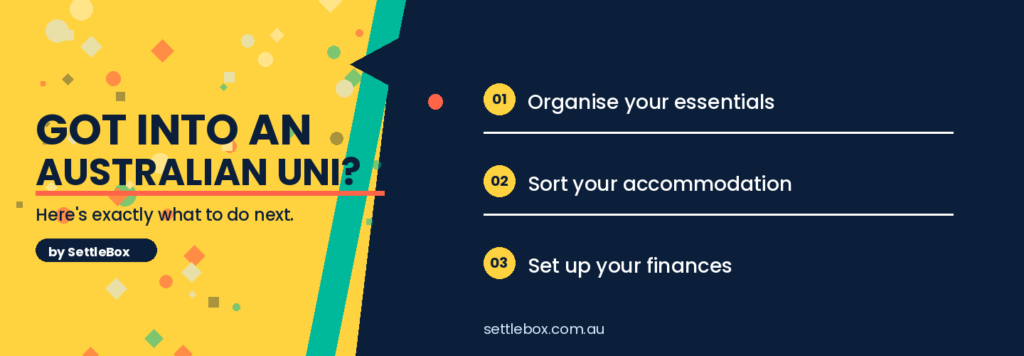

What to do after getting into an Australian university is a question nobody really prepares you for. You refreshed the email about fifty times. And then it came. Your offer letter. Your COE. Your visa approval. And then, almost immediately, you had absolutely no idea what to do next. This guide covers exactly what to do after getting into an Australian university, in the right order.
Nobody prepares you for that gap between getting in and actually getting there. The university sends you a welcome email. Your parents are excited. Your friends want to celebrate. But you are sitting there quietly wondering: what do I actually need to do, in what order, and how do I not mess this up?
I know that feeling because I lived it. I moved to Adelaide to study and my visa came through after orientation week had already started. I booked a last minute flight, landed in a city I had never been to, and was dropped at my student accommodation the next morning with a full day of university ahead of me and a room that had nothing in it.
Nobody handed me a checklist. So this is the one I wish I had.
The gap between getting accepted and feeling settled is longer than anyone tells you. This guide is about closing that gap and tells you what to do after getting into an Australian university — the full checklist
Step 1: Accept your offer and get your COE
Your Confirmation of Enrolment (COE) is the document that makes everything else possible. Without it, you cannot apply for a student visa. Without a visa, you cannot get on the plane.
Once you receive your offer letter from the university, you need to formally accept it and pay your first semester’s tuition (or at least a deposit). The university then issues your COE, usually within a few business days.
Things to do at this stage:
- Accept your offer through the university’s student portal
- Pay tuition fees or deposit as required
- Save your COE document as a PDF and back it up to cloud storage
- Check your course start date and work backwards from there for all your planning
One thing most students do not realise: your COE is tied to a specific course start date. If your plans change, you need to update your COE. Do not assume flexibility that is not there.
Step 2: Apply for your student visa (subclass 500)
The Australian student visa is called Subclass 500. You apply through ImmiAccount, the Australian government’s online immigration portal. Processing times vary, typically between 4 and 8 weeks depending on your country, the time of year, and whether your application is straightforward.
This is where most students get their first real stress. Visa processing feels like a black box. You submit everything, and then you wait.
What you need for your Subclass 500 application:
- Your COE
- Valid passport (check it is not expiring within 6 months of your intended stay)
- Genuine Temporary Entrant (GTE) statement explaining why you are studying in Australia and intending to return home
- Proof of financial capacity (bank statements showing you can support yourself)
- Overseas Student Health Cover (OSHC) for the duration of your course
- English language test results if required (IELTS, PTE, TOEFL)
- Academic transcripts
Two things that catch people out. First, the financial requirement. Australia expects you to show you can cover tuition plus living costs, typically around AUD $29,710 per year for living expenses on top of your fees. If you are relying on family funds, get a bank statement and sometimes a statutory declaration. Second, OSHC. You must purchase health cover before you apply and include it in your application. Companies like Bupa, Medibank, nib, and CBHS all offer OSHC. Shop around but make sure the dates cover your full course.
Step 3: Sort accommodation before you do anything else
This is the step most students leave too late. And it is the one that causes the most panic.
Australian university accommodation fills up fast, especially for July intake. On-campus student housing often has waitlists of several months. If you are applying for Semester 2 (July start), you should be looking at accommodation in March or April at the latest.
Your options in order of ease:
On-campus student residences:
most convenient, usually includes meals, good for meeting people, book early
Purpose-built student accommodation (PBSA):
private providers like Scape, UniLodge, Urbanest, Student One. More expensive but flexible contracts and bills included
Shared house or apartment:
cheapest but hardest to arrange from overseas. Use Facebook groups, Flatmates.com.au, or your university’s student noticeboard
Homestay:
living with an Australian family. Good for language immersion, usually includes breakfast and dinner
One honest piece of advice: if you can at all manage it, try to arrive in Australia at least two to four weeks before your course starts. The students who arrive early have time to find their feet, sort their room, open a bank account, get a SIM card, and actually sleep before the semester begins. The students who arrive the day before orientation week are the ones who feel behind for the first two months.
I arrived in Adelaide the same week my university started. I had one orientation session the morning after landing. I was jet-lagged, my room had nothing in it, and I had a full day of university ahead of me. I would not recommend it.
Step 4: Get OSHC sorted and understand what it covers
Overseas Student Health Cover is not optional. It is a visa condition. But beyond the legal requirement, you actually need it.
Australia’s healthcare system is excellent but it is not free for international students the way Medicare is for residents. OSHC covers visits to the doctor, some hospital treatment, and limited pharmaceuticals. What it does not always cover well: dental, optical, and specialist appointments.
Read your policy. Know what the excess is. Know where your nearest bulk-billing GP is. A bulk-billing GP charges Medicare directly, which means some OSHC providers will cover the visit entirely. This matters when you get sick in week two and just need to see a doctor without worrying about a $90 bill.
Step 5: Book your flight strategically
Once your visa is granted, the temptation is to book the cheapest flight you can find. Resist this slightly.
A few things to think about when booking:
- Arrive at least one to two weeks before semester starts if you possibly can. Orientation weeks matter and the friendships you make in that first week carry through your entire degree
- Check your baggage allowance carefully. International flights to Australia often include 23 to 30kg checked baggage. Economy class on budget carriers may be much less
- Consider what you are packing. Bedding, kitchen items, and bathroom basics add significant weight. Buying essentials in Australia is often more practical than carrying them, and a SmartPack can have them waiting at your door
- Screenshot your e-visa confirmation. Border Force will ask for it and your phone signal may be poor at the airport
Step 6: Plan your finances and open a bank account
This is the step that stresses students out more than almost anything else because it involves things that are hard to do before you arrive but become urgent the moment you land.
Opening an Australian bank account: you can apply before you arrive with most major banks. CommBank, ANZ, NAB, and Westpac all have processes for international students to open accounts before landing. Do this at least two weeks before arrival so your card is ready when you get there. You will need your passport, COE, and an Australian address (your accommodation address works).
For sending money from home: Wise (formerly TransferWise) offers significantly better exchange rates than bank-to-bank transfers. If your family is sending money to support you, set this up early. The difference on a $5,000 transfer can be $150 or more.
Realistic first-month costs as an international student in Australia:
- Accommodation: $800 to $1,800 depending on city and type
- Groceries: $250 to $400
- Transport: $80 to $150 (get a Opal, Myki, or Go card depending on your city)
- Phone plan: $15 to $40 per month for a SIM-only plan
- Household basics and setup: $200 to $600 if buying everything new
- Social and unexpected: $100 to $300
That last line is real. Your first week will involve spending you did not plan for. I walked 1.5km to a shopping centre on my first full day in Adelaide to buy something for a party I had just been invited to. I had not budgeted for that. I was jet-lagged and navigating an unfamiliar city on foot. It was fine, but it was also completely avoidable chaos.
Step 7: Sort the basics before you land
Here is something most advice articles do not tell you because most advice articles are not written by people who have actually done this.
The practical stuff, your bedding, your towels, your kitchen basics, your bathroom supplies, takes time and energy to sort after you land. And when you land, you have no energy. You are jet-lagged. You do not know where anything is. Everything costs more than you expect when you are buying it urgently and in small quantities from a convenience store near your accommodation.
The students who have a good first week are almost always the ones who sorted these things before they arrived. Either they had someone help them, or they had things delivered before they got there.
That is exactly why SettleBox exists. A SmartPack is a set of essentials, bedding, bathroom basics, kitchen must-haves, delivered to your address before you land. You open the door to your new room and things are already there. You do not need to navigate a shopping centre while jet-lagged. You do not need to carry 30kg of linen through an airport.
Pre-order your SmartPack now. Dispatching 5 June.
Choose Lite, Plus, or Pro depending on how much you want sorted before you land. Every SmartPack is delivered to your Australian address before your arrival date. Order at least 21 days before landing and we guarantee early dispatch.
Compare SmartPacks and order yours
Step 8: The things nobody tells you
A few honest observations from someone who has lived this:
The gap between landing and feeling settled is longer than anyone says. Most people tell you that after a week or two you will feel at home. The reality is it takes most international students two to three months to feel genuinely settled. That is not a problem. That is normal. But it helps to know it is coming so you do not interpret the first month of disorientation as something going wrong.
Your social life will largely be determined by your first two weeks. The people you meet in orientation week, in your accommodation corridor, in your first tutorial become your network. Arrive early if you can. Say yes to things even when you are tired.
Australian university workload hits differently. Continuous assessment, tutorials where you are expected to contribute, group assignments with strangers. If your previous education was primarily exam-based, expect an adjustment period. Use your university’s student support services early, not when you are already struggling.
Get a TFN as soon as possible. A Tax File Number is what you need to work legally in Australia. You can apply online through the Australian Tax Office (ATO) once you have arrived. Without it, employers are required to withhold tax at the highest rate. Apply in your first week.
The first shopping trip costs more than you expect. Every international student I have ever spoken to says the same thing: their first supermarket run was a shock. Everything from Woolworths and Coles feels expensive when you are converting from rupees, dong, or ringgit. You adjust. But that first trip, buying everything at once in an unfamiliar system, stings. Plan for it.
The full checklist
Before you do anything else, save this.
Before visa application:
- Accept offer and receive COE
- Purchase OSHC for full course duration
- Prepare financial evidence (bank statements, family support letter)
- Complete GTE statement
- Apply for Subclass 500 via ImmiAccount
Once visa is granted:
- Book flights (aim to arrive 2 to 4 weeks before semester)
- Confirm accommodation and get your Australian address
- Open Australian bank account before arrival
- Set up Wise or similar for receiving money from home
- Order your SmartPack for delivery before arrival
- Arrange airport pickup (university shuttles, friend of family, or rideshare)
First week in Australia:
- Get a SIM card (Woolworths Mobile, Optus, or Telstra all have student plans)
- Activate your bank account and set up tap-to-pay on your phone
- Apply for your TFN online through the ATO
- Get your transport card for your city (Opal in Sydney, Myki in Melbourne, Metrocard in Adelaide)
- Register at your university student services office
- Find your nearest bulk-billing GP and save the number
- Attend orientation if you can, even the parts that feel unnecessary
You are about to do something genuinely difficult and genuinely exciting. The admin is annoying. The waiting is hard. But the moment you land and your first few days are sorted, everything opens up.
Make the planning phase the easy part. The rest of it you figure out as you go.